


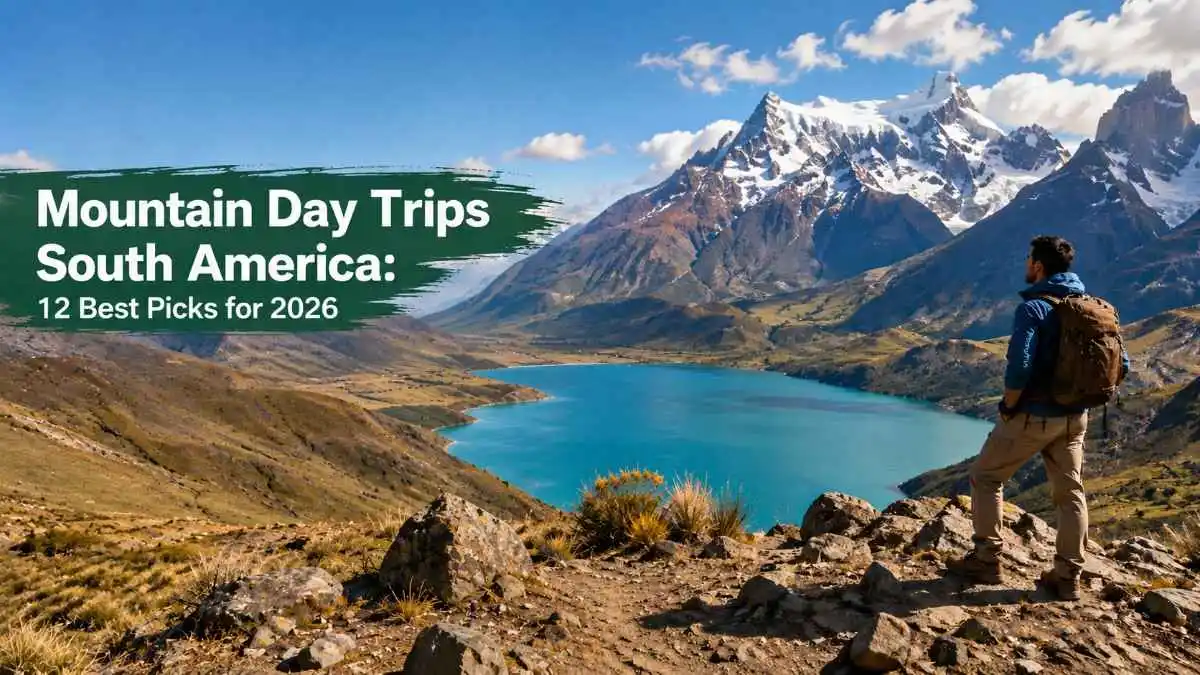
Mountain day trips South America visitors can complete in 1 day include crater lakes, snowy volcanoes, high-altitude lagoons, cloud forests, and Patagonia trails. Some start beside a city. Others need a 3:00 a.m. pickup and several hours on mountain roads.
The right choice depends on 4 details: altitude, walking time, total transport, and weather. A 2-hour walk at 5,000 m can feel harder than a 6-hour walk near sea level. This guide compares the full day, including current fees and common tour prices, so you can choose a trip that fits your body and budget.
For lower-altitude ideas, read my Nature Day Trips South America guide. Travelers planning several walking days can also compare the routes in my Mountain Hiking South America guide.
1. Rainbow Mountain from Cusco, Peru

Best for: famous high-altitude views
Day length: 12 to 14 hours
Difficulty: moderate walking, very hard altitude
Good months: May to September
Rainbow Mountain, also called Vinicunca, is one of the most booked mountain day trips from Cusco. Most group vans leave between 3:00 and 4:00 a.m. The drive, breakfast stop, hike, lunch, and return can fill nearly the full day.
The walk is shorter than many people expect. Altitude causes most of the strain. The viewpoint sits above 5,000 m, and cold wind can make slow progress feel harder. Spend at least 2 full days in Cusco or the Sacred Valley before booking it.
The official visitor price is S/30 for international travelers. Group trips commonly sit between about $39 and $100 in 2026, depending on the group size, meals, entry, and service level.
A cheap ticket can leave several costs outside the price. Check for entrance, breakfast, lunch, oxygen, pickup, Red Valley, and toilet charges. Carry S/80 to S/150 in cash for optional costs and emergencies.
My full Rainbow Mountain Peru Guide lists the usual schedule, cash needs, and booking checks.
Choose this trip after a clear, symptom-free day in Cusco. Palccoyo is a better choice for travelers who want a shorter walk at a similar altitude.
2. Humantay Lake from Cusco, Peru
Best for: a turquoise glacial lake
Day length: 12 to 14 hours
Difficulty: hard
Good months: May to September
Humantay Lake sits below snow-covered peaks in the Salkantay area. Day tours usually leave Cusco around 4:00 a.m., stop for breakfast, drive to Soraypampa, and return during the early evening.
The main climb is short and steep. Most travelers need 1.5 to 2.5 hours to reach the lake and about 1 to 1.5 hours to descend. The lake sits near 4,200 m, so your pace may be much slower than it would be at home.
Street agencies in Cusco advertised shared 2026 tours around S/80 to S/130. Online bookings often cost $35 to $55. Entrance commonly adds about S/20 to S/30 when it is excluded.
Read the inclusion list because low prices can mean a crowded van, a large group, or a separate meal charge.
Humantay suits travelers who prefer a lake to Rainbow Mountain’s striped rock. It still needs altitude preparation. Give yourself 2 easy days in Cusco first, wear shoes with grip, and bring poles for the descent if your knees hurt on steep ground.
3. Laguna 69 from Huaraz, Peru

Best for: a demanding lake hike below snowy peaks
Day length: 12 to 14 hours
Difficulty: hard
Good months: May to October
Laguna 69 is one of the strongest full-day hikes in Peru. The trail begins at Cebollapampa inside Huascarán National Park. It climbs through open valleys, waterfalls, and steep switchbacks to a bright blue lake near 4,600 m.
Most shared trips leave Huaraz before sunrise. Expect about 5 to 7 hours of walking and a long road transfer through the Llanganuco area. A standard shared trip often costs $15 to $30 before park entry.
The official park lists Laguna 69 as a 1-day route, recommends May to October, and requires visitors to use authorized operators.
Spend 2 or 3 nights in Huaraz before this hike. A light walk to a lower lake or viewpoint gives your body a safer test. Laguna 69 is a poor choice for your first morning after an overnight bus from Lima.
Huaraz has several cheaper routes, so stay for at least 4 days when possible. My Budget Hiking Destinations South America guide compares Huaraz with El Chaltén, Quilotoa, Cocora Valley, and other bases.
4. Quilotoa Crater Lake from Quito, Ecuador

Best for: crater views with flexible walking
Day length: 10 to 12 hours from Quito
Difficulty: easy to hard, based on route
Good months: June to September
Quilotoa is a volcanic crater filled by a blue-green lake. The rim sits near 3,900 m. You can spend 30 minutes at the main viewpoint, walk down to the water, or complete a longer rim section.
A shared day tour from Quito commonly costs about $55 to $100. Independent travel can cost less, though bus changes make the day longer and leave less time at the crater. A current group tour lists a return to Quito around 5:30 to 6:30 p.m.
The descent to the lake feels easy at first. The return climb is steep and takes much longer. Save enough energy and time for the ascent. Horses may be present, though availability and animal welfare standards vary.
Quilotoa fits travelers who want a mountain day without a fixed long hike. The viewpoint alone still gives a good visit. For a multi-day route through nearby villages, use my Quilotoa Loop Guide.
5. Cotopaxi National Park from Quito, Ecuador
Best for: volcano views and a short high-altitude test
Day length: 9 to 12 hours
Difficulty: easy to hard, based on altitude
Good months: June to September
Cotopaxi is one of the easiest places to reach a very high mountain setting from a capital city. Quito sits above 2,800 m, and the park entrance starts near 3,500 m. Many day tours visit Limpiopungo Lagoon and then drive higher if road and weather conditions allow.

The flat lagoon walk takes about 1 hour at roughly 3,800 m. The José Ribas refuge sits at 4,800 m. Its short approach from the upper parking area can take 45 to 60 minutes because the ground is loose and the air is thin.
Park entry is free, though transport inside the park and a guide can add to the cost. Current Quito day tours start around $56 to $60, with other operators charging about $85.
Choose Limpiopungo when you have limited hiking experience or have just reached Quito. Add the refuge only when you feel well and have spent time at altitude.
Ecuador’s official tourism guidance recommends rest and a gradual ascent because Quito and the highlands already sit above 2,800 m. Clearer volcano weather is more common in the June to September dry season.
6. Cocora Valley from Salento, Colombia

Best for: green mountains, wax palms, and route choice
Day length: 5 to 8 hours
Difficulty: easy to moderate
Good months: December to February and June to August
Cocora Valley is the easiest all-round choice in this guide. Willys Jeeps run from Salento’s main square to the valley in about 20 to 30 minutes. You can visit the main palm viewpoints, ride a horse, or hike the full cloud-forest loop.
The full loop is about 12 km and usually takes 4 to 6 hours. Some upper sections climb above 2,700 m. Mud, rain, and repeated slopes create more difficulty than the altitude for many visitors. Early departures bring cooler weather and a better chance of open views.
A return Willys Jeep from Salento costs about COP 12,000. The main palm area and private trail sections add separate cash fees. Plan about $15 to $35 for transport, entry, food, and an optional reserve stop.
Carry Colombian pesos because card payment may be unavailable.
This trip works for mixed-fitness groups. One person can do the full loop, and another can stay near the palm viewpoints.
My Cocora Valley Colombia Guide explains the clockwise and counterclockwise routes, jeep timing, fees, and muddy sections.
7. Monserrate from Bogotá, Colombia
Best for: a short mountain trip inside a capital
Day length: 3 to 5 hours
Difficulty: easy by cable car, moderate on foot
Good months: year-round
Monserrate rises above central Bogotá and reaches 3,172 m. It is the most practical choice for travelers who have only half a day. You can go up by cable car or funicular, or use the pedestrian path when it is open.
Monserrate’s summit is 3,172 m above sea level. The 2026 return fare is COP 35,000 from Monday to Saturday and on holidays. Sunday return tickets cost COP 21,000.
The walking path is free, though you should confirm its same-day opening time and condition before leaving.
Bogotá already sits high, so the uphill route can feel tiring. Walk during daylight, carry water, and keep your phone out of sight on quiet approach streets. A cable-car ascent and walking descent gives you the view with less strain.
Monserrate is a good arrival-day plan for an experienced high-altitude traveler. New arrivals can take the transport both ways and keep the visit short.
8. Cajón del Maipo from Santiago, Chile

Best for: an Andes road day with little required walking
Day length: 8 to 11 hours
Difficulty: easy to moderate
Good months: October to April for easier roads
Cajón del Maipo has rivers, reservoirs, mountain villages, hot springs, and trail options east of Santiago. Most first visits focus on San José de Maipo and Embalse El Yeso.
Embalse El Yeso sits at about 2,500 m. Group tours from Santiago commonly include transport, a viewpoint stop, and a picnic. Prices often fall near $40 to $100 based on the route and season.
Access can change after snow, rockfall, or road work, so confirm the exact stop before booking. Chile’s official tourism site lists Embalse El Yeso, Termas Valle de Colina, and El Morado as the area’s main places to visit.
This is a strong choice for travelers who want mountain views without a hard trail. It also fits a group with children or older adults when road conditions are good. Choose El Morado on a separate day if hiking is your main goal.
9. Farellones and Valle Nevado from Santiago, Chile

Best for: a snow day close to Santiago
Day length: 9 to 12 hours
Difficulty: easy unless skiing
Good months: June to September
Farellones and Valle Nevado are the main winter mountain choices near Santiago. Farellones suits first-time snow visitors because it has tubing, sledding, zip lines, and a chairlift. Valle Nevado suits skiers and travelers who want a higher resort setting.
Shared transport from Santiago starts around CLP 40,000, or about $40 to $45, before park passes, rental gear, lessons, and food. A full ski day can pass $180 after these extras.
Chile’s 2026 snow guidance places the usual season from June to September, with more reliable activity coverage in July and August.
The 46 km road to Valle Nevado has many hairpin turns. Winter vehicles must carry and use chains when required. High-season weekends can have separate uphill and downhill traffic periods. A transfer removes the stress of driving and parking.
Pick Farellones for snow play. Pick Valle Nevado for skiing or a resort lunch. Check snow depth and operating status before paying because early and late season conditions change fast.
10. Chacaltaya from La Paz, Bolivia
Best for: reaching extreme altitude with limited walking
Day length: 7 to 9 hours
Difficulty: short, steep, and very high
Good months: May to October
Chacaltaya rises to about 5,421 m near La Paz. A mountain road reaches the old ski area, followed by a short uphill walk. Many tours combine it with the Valley of the Moon.
Current shared tours commonly start around $38 to $50. Private and small-group choices can cost more. The whole trip usually takes 7 to 8 hours.
The short distance can give a false sense of ease. Oxygen is limited above 5,000 m, and wind can be severe. Spend at least 2 or 3 nights in La Paz first. Turn around as soon as you develop a strong headache, nausea, poor balance, or unusual weakness.
Chacaltaya is better for travelers who want a high viewpoint than those seeking a long hike. Charquini gives a longer walking day and often includes a glacial lake, though it needs the same careful altitude planning.
11. Laguna de los Tres from El Chaltén, Argentina
Best for: the strongest full-day hike on this list
Day length: 8 to 10 hours
Difficulty: hard
Good months: November to March
Laguna de los Tres is the classic day hike below Mount Fitz Roy. The standard return route from El Chaltén covers about 20 km and gains around 750 m. Forest, river, and open mountain sections lead to a final steep climb.

The last ascent gains about 400 m and takes a little over 1 hour for many hikers. Loose ground, wind, and tired legs make the descent demanding too. Start early and carry a headlamp, food, warm layers, and rain protection.
Los Glaciares National Park charges ARS 50,000 for a general 1-day ticket in the El Chaltén North Zone. A 3-day general pass costs ARS 100,000.
Buy online before leaving because signal and payment at the trail entrance can cause delays.
This route needs a full day and clear enough weather to justify the effort. Keep 2 possible hiking days in El Chaltén, then use the better forecast.
Read my Fitz Roy Hike Guide for the route plan, or compare shorter choices in my El Chaltén Hikes Guide.
12. Mount Campanario and Circuito Chico from Bariloche, Argentina
Best for: an easy mountain and lake day
Day length: 3 to 6 hours
Difficulty: easy
Good months: October to April
Mount Campanario gives one of Bariloche’s easiest wide viewpoints. The base sits on the Circuito Chico route and can be reached by local bus, car, or a half-day tour.
The chairlift reaches the summit in about 7 minutes. Active visitors can walk up. The top sits near 1,050 m, so altitude is rarely a problem.
Combine Campanario with Llao Llao, lakeside stops, and a short forest walk on Circuito Chico. Independent bus travel keeps the day cheap. A tour or rental car gives more control over stops.
Plan about $10 to $40 before meals, based on transport and whether you use the chairlift.
This is the best choice after several hard hiking days. It also suits families, mixed-age groups, and travelers who want mountain views with a low risk of altitude symptoms.
How to choose the right mountain day trip
Choose by physical effort
Pick Mount Campanario, Monserrate by cable car, Cajón del Maipo, or the short Cocora route for a lighter day.
Choose Quilotoa, Cotopaxi’s lagoon, or Humantay Lake for a moderate day. Their walking distances are manageable, though altitude can slow you down.
Choose Laguna 69 or Laguna de los Tres for a full hiking day. Both need early starts, enough food, and good shoes. Laguna 69 adds much higher altitude. Laguna de los Tres adds more distance and fast Patagonia weather.
Choose by altitude
Trips below 3,000 m include Cocora Valley, Cajón del Maipo, Mount Campanario, and Laguna de los Tres. These are easier to add early in a trip for most healthy travelers.
Monserrate and Quilotoa sit above 3,000 m. A slower pace still matters.
Humantay, Laguna 69, Cotopaxi refuge, Rainbow Mountain, and Chacaltaya reach above 4,000 m. Put them later in your stay.
Mild exercise during the first 48 hours at altitude is safer than a hard first-day hike. Avoid alcohol during those first 48 hours.
Choose by season
Peru’s Cordillera Blanca has its driest hiking period from May to October. Ecuador’s clearer volcano months commonly run from June to September.
Santiago’s snow trips usually run from June to September. Patagonia’s main hiking period runs from November to March.
Cocora Valley and Monserrate work through the year. Rain can still change trail conditions and visibility.
Choose by budget
The cheapest easy trips are Monserrate on foot, Cocora Valley, and Mount Campanario by local bus and walking trail.
Shared group trips give the best value for Rainbow Mountain, Humantay Lake, Laguna 69, Quilotoa, Cotopaxi, Cajón del Maipo, and Chacaltaya.
Compare the full inclusion list. Transport, entry, meals, guide language, group size, oxygen, and return time matter more than a small price difference.
Argentina needs a larger budget because park passes, buses, beds, and meals cost more. Chile’s snow days become costly after adding rental clothes, activity passes, skiing, and food.
A safer order for high-altitude trips
Use the first day in Cusco, Quito, Huaraz, or La Paz for rest and light walking. Add an easy city or valley outing on day 2. Place the highest mountain trip on day 3 or later when you feel well.
Headache, tiredness, poor appetite, dizziness, and nausea can be signs of acute mountain sickness. Symptoms often begin 2 to 12 hours after reaching a higher elevation.
Stay at the same level when symptoms are mild. Descend and seek medical care when symptoms get worse, or when confusion, poor coordination, coughing, or shortness of breath appear.
Avoid stacking Rainbow Mountain and Humantay Lake on back-to-back days. The same rule applies to Cotopaxi refuge after Quilotoa, or Chacaltaya after another high Cordillera Real trip. A rest day gives you time to judge how your body reacted.
What to pack for a South America mountain day

Carry these items even when transport and meals are included:
- 1.5 to 2 litres of water for a long hike
- A waterproof jacket
- A warm mid-layer
- Sun hat, sunglasses, and sunscreen
- Broken-in shoes with grip
- Cash in small local notes
- Lunch or high-energy snacks
- Toilet paper and hand sanitizer
- Phone with an offline map
- Portable charger
- Passport or a copy accepted by the park
- Headlamp for long trails
- Trekking poles for steep descents
Use several thin layers. Temperatures can change between a dark early pickup, strong midday sun, rain, and cold wind.
Booking checks that prevent bad day trips
Ask for the exact pickup place and return window. A tour listed as full day may return at 4:00 p.m. or 8:00 p.m.
Request a written list of included costs. Check park entry, meals, water, guide language, group size, oxygen, toilets, activity passes, and hotel pickup.
Confirm the final destination. Cajón del Maipo tours may use different reservoir or picnic stops when roads close. Cotopaxi tours may stop below the refuge. Snow trips may run with limited activities during poor conditions.
Read recent reviews about the vehicle and guide. A low price loses value when the van is unsafe, the group is too large, or the guide rushes sick travelers.
Keep one weather buffer day for El Chaltén, Huaraz, and high Cusco trips. Clouds can hide the main view after you have paid and traveled for hours.
For more low-cost planning, compare these trips with my Budget Day Trips South America guide.
Final choice
First-time mountain travelers should start with Cocora Valley, Mount Campanario, Monserrate, or Cajón del Maipo. Each gives clear route choices and a shorter recovery time. Quilotoa and Cotopaxi work well after 1 or 2 easy days in Quito.
Fit and acclimatized hikers can choose Laguna 69, Rainbow Mountain, Chacaltaya, or Laguna de los Tres. Check the altitude, total walking, and return time before booking. The best day is the one that matches your current fitness and the conditions on that date.


