


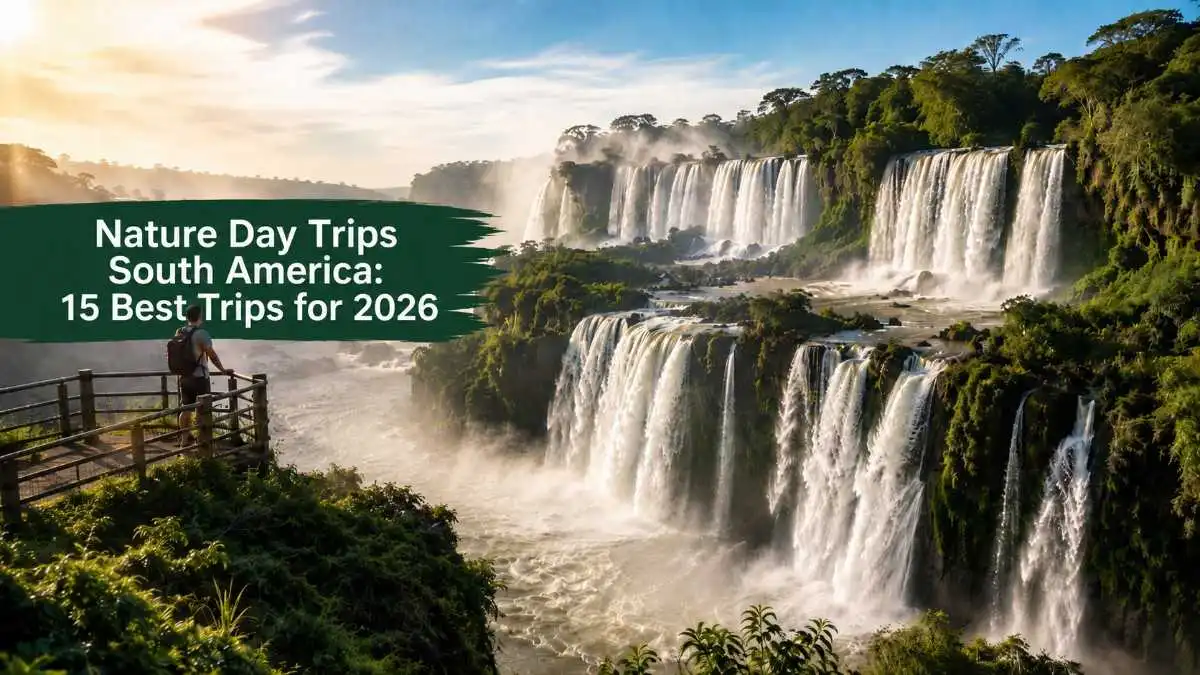
Nature day trips South America travellers can take range from rainforest walks and glacier viewpoints to high-altitude lakes, waterfalls, wildlife islands, and desert geysers. Many start from cities or small travel bases, so you can see a major natural place without booking a long multi-day route.
The right trip depends on travel time, altitude, fitness, weather, and cost. This guide compares 15 strong choices, explains who each trip suits, and gives current access notes for 2026.
How to choose the right trip
Pick the experience first. Iguazú suits travellers who want a famous sight with clear paths. Cocora Valley and Mindo suit people who prefer green scenery and lighter walking. Laguna de los Tres and Rainbow Mountain suit fit hikers who can handle a long or high-altitude day.
Then check the full door-to-door time. A place may look close on a map, yet slow roads, border checks, boat schedules, or early departures can turn it into a 12-hour day.
Altitude needs its own check. Rainbow Mountain, El Tatio, Lake Titicaca, and Quilotoa sit far above sea level. Plan at least 2 nights at altitude before the hardest trip when possible. Drink water, eat a light breakfast, and turn back if you develop severe headache, confusion, chest tightness, or trouble walking.
1. Iguazú Falls from Puerto Iguazú or Foz do Iguaçu
Best for: first-time visitors, families, photographers
Typical day: 6 to 9 hours
Physical level: easy to moderate
Iguazú Falls is one of the easiest major nature sights to fit into a single day. The Argentine side has forest paths, viewing platforms, park trains, and several waterfall circuits. The Brazilian side gives wider views across the falls and usually takes less time.
For one full day, choose one country rather than rushing across the border. The Argentine side suits travellers who want more walking and closer viewpoints. The Brazilian side suits a shorter schedule or a travel day with limited time.
Argentina’s official 2026 general entrance fee is ARS 60,000 from 1 June 2026. The ticket includes the marked trails, train, and open circuits, though parts of the park can close after heavy rain or high river levels. Check the park notice before leaving your hotel.
Bring a light rain jacket, a dry bag for your phone, insect repellent, and shoes with grip. Clothes can get wet even on a clear day.
For entry details, transport options, border planning, and the best viewpoints, read the Iguazú Falls Travel Guide.
2. Perito Moreno Glacier from El Calafate
Best for: easy walking, glacier scenery, older travellers
Typical day: 7 to 10 hours
Physical level: easy
Perito Moreno is the most practical glacier day trip in Argentine Patagonia. Buses and tours leave El Calafate for the glacier walkways, where several platforms show the ice from different heights and angles.

The walkway system makes this trip suitable for people who do not want a hard hike. You can spend hours watching the glacier face and listening for ice breaks. Boat trips and guided ice activities cost extra and need advance booking.
Los Glaciares National Park lists a general entrance fee of ARS 50,000 from 1 June 2026. The park also advises visitors to carry drinking water, since services can be limited near some viewing areas. El Calafate is the main access town for Perito Moreno and other glacier trips.
Wind can make the temperature feel much colder than the forecast. Pack a warm layer, gloves, and a waterproof outer layer even in summer.
3. Torres del Paine road trip from Puerto Natales
Best for: mountain views without a long hike
Typical day: 10 to 13 hours
Physical level: easy
A road-based Torres del Paine day trip covers lakes, mountain viewpoints, short walks, and possible wildlife sightings. It works well for travellers who have one spare day in Puerto Natales and cannot book a longer Patagonia route.

Many full-day road trips stop at several equipped viewpoints. Routes differ with weather, road conditions, and park rules, so compare the exact stops before paying. A tour that includes too many photo stops may leave little time for walking.
The 2026 daily foreign adult fee is CLP 32,400. Winter access changes each year. For example, the W route closed from 1 June to 31 July 2026, while the Base Torres route required an accredited winter guide. Check the official park updates for your date.
Choose a road tour if your main goal is scenery. Choose a separate Base Torres hiking day only if you have strong fitness, suitable weather, and the correct seasonal access.
4. Laguna de los Tres from El Chaltén
Best for: strong hikers, Fitz Roy views, low transport cost
Typical day: 8 to 10 hours
Physical level: hard
Laguna de los Tres is the strongest hiking choice on this list. The route starts near El Chaltén, so you do not need a long vehicle transfer. The final climb is steep and tiring, especially in wind or loose ground.

Start early and carry your full food and water supply. Weather can change within an hour. Turn back before the last climb if cloud, wind, ice, or fatigue makes the route unsafe.
The main El Chaltén trails are commonly walked without a guide during the dry summer season, though access rules and trail conditions can change. The FrugalVoyage El Chaltén Hikes guide has route details, difficulty notes, costs, and a 3-day plan.
This trip gives the best value for fit travellers already staying in El Chaltén. Your main costs are food, local accommodation, and any current park or trail charge.
5. Uyuni Salt Flats from Uyuni
Best for: wide views, easy activity, unusual photos
Typical day: 9 to 12 hours
Physical level: easy
A full-day Uyuni trip usually uses a shared 4×4 vehicle. Common stops include the train cemetery, salt-processing areas, the salt flats, cactus-covered islands when accessible, and a sunset stop.

The dry season gives a white salt surface and long-distance views. The wet season can create the famous reflection effect, though flooded areas may block some routes. Your driver chooses the route based on surface conditions.
One-day trips are widely sold from Uyuni. A same-day trip from La Paz is not practical by road, so travellers often use an overnight bus or flight and begin the tour in Uyuni.
Ask whether the price includes lunch, entry charges, sunset time, and hotel pickup. Shared tours can feel rushed, so read recent reviews about driver safety and vehicle condition.
6. El Tatio Geysers from San Pedro de Atacama
Best for: desert scenery, geothermal activity, early risers
Typical day: 6 to 8 hours
Physical level: easy, with high-altitude risk
El Tatio sits at about 4,300 metres above sea level. Tours usually leave San Pedro de Atacama around 4:00 am because the geyser activity is easiest to see near sunrise.
The trip has little hard walking, yet the altitude and cold can make it tiring. Chile’s official travel site says El Tatio is about 80 kilometres from San Pedro, with a drive of roughly 1 hour 30 minutes. Dawn temperatures can fall to about -20°C in cold periods.
Wear warm layers that can be removed after sunrise. Carry water, lip balm, sunscreen, and gloves. Avoid alcohol the night before, and tell the guide if you feel dizzy, sick, confused, or unusually weak.
7. Cajón del Maipo from Santiago
Best for: a flexible Andes day near a capital city
Typical day: 8 to 11 hours
Physical level: easy to moderate
Cajón del Maipo is the most practical mountain day trip from Santiago. The area has river valleys, mountain roads, picnic stops, thermal baths, and the Embalse El Yeso reservoir.
Your route depends on season and road access. Some travellers book a shared tour, while others rent a car. Self-driving gives more control, though mountain roads and winter conditions need care.
The main valley begins about 50 kilometres from Santiago along Route G-25. Embalse El Yeso access can require a prior reservation and ticket, and opening days may be limited. Check the current reservoir and road rules before setting out.
A good day plan has 2 or 3 main stops. Long lists of minor stops often mean more time in the vehicle and less time outside.
8. Rainbow Mountain from Cusco
Best for: high-altitude scenery, fit travellers, guided day tours
Typical day: 12 to 14 hours
Physical level: hard
Rainbow Mountain is a long day with an early departure, several hours of driving, and a steep high-altitude walk. The viewpoint sits above 5,000 metres, so the short distance can feel much harder than a longer hike at lower elevation.
Spend at least 2 full days in Cusco before this trip. Walk slowly, carry water, and keep your backpack light. Horses may be available for part of the route, yet they do not remove the final walking section or altitude risk.

The Cusipata route was reported fully operational in February 2026, with later local updates confirming access conditions during the year. Check again shortly before your trip because community agreements, weather, and road work can change the approach.
Use the FrugalVoyage Rainbow Mountain Peru Guide for the route, altitude advice, current cost categories, packing list, and timing plan.
9. Paracas Reserve and Ballestas Islands
Best for: wildlife, coastal desert, travellers who avoid hiking
Best base: Paracas, or Lima with a very early start
Typical day: 6 to 12 hours
Physical level: easy
The Ballestas Islands boat trip has sea lions, seabirds, and possible Humboldt penguin sightings. Boats leave from Paracas, then return in time for a drive through the coastal reserve.

SERNANP lists Ballestas visiting hours from 6:00 am to 1:00 pm and requires an authorised tour operator. The official adult fee is S/11, or S/17 for a combined Ballestas and Paracas Reserve ticket. The boat trip takes about 1 hour 40 minutes.
The Paracas Reserve’s northern circuit covers about 26 kilometres and can take 4 to 6 hours with stops. Official travel guidance puts Paracas around 4 hours from Lima by road, so a Lima day trip is long. Staying 1 night in Paracas gives a calmer schedule.
Bring a windproof layer. The boat can feel cold even when the town is warm.
10. Lake Titicaca islands from Puno
Best for: lake views, boat travel, local culture
Typical day: 7 to 10 hours
Physical level: easy, with high-altitude risk
Full-day boat trips from Puno often visit the Uros floating islands and one larger island, depending on the operator and boat speed. The day has little hard walking, yet steps and slopes can feel tiring at altitude.

Lake Titicaca sits around 3,810 metres above sea level, and Puno is slightly higher in some areas. Spend time adjusting before a long boat day if you arrived from a lower city.
Choose an operator that explains the schedule, community fees, meal stop, and return time. Very cheap trips may include long sales stops or give little time on the larger islands.
Pack sunscreen, a hat, water, and a warm layer. Sun exposure is strong on the lake, while wind can turn cold quickly.
The Lake Titicaca Travel Guide explains the best islands, boat costs, accommodation, and how many days to stay.
11. Quilotoa crater lake from Quito
Best for: crater views, a moderate hike, budget travellers
Typical day: 10 to 12 hours
Physical level: moderate
Quilotoa is a volcanic crater lake south of Quito. Most day trips stop at the rim, then give time to walk partway down toward the lake. The return climb is steep because of the altitude and loose surface.
A day tour is easier than public transport because the route can involve several buses and fixed departure times. Travellers with more time get a better visit by staying overnight or walking part of the Quilotoa Loop.
Recent travel information places Quilotoa about 3 hours south of Quito, and the crater rim sits close to 4,000 metres. The local tourism site says crater access is currently free, though parking, local activities, transport, and tour charges still apply.
Cloud often builds later in the day. An early arrival gives a better chance of clear lake views.
Travellers planning more than a day trip can use the Quilotoa Loop Guide for the full route, costs, transport, and 3-day itinerary.
12. Mindo Cloud Forest from Quito
Best for: birds, waterfalls, families, mixed fitness levels
Typical day: 9 to 11 hours
Physical level: easy to moderate
Mindo is a green cloud-forest town west of Quito. A day can include birdwatching, a cable car, waterfall paths, a butterfly garden, or a chocolate visit.
Choose 2 main activities. Trying to fit every attraction into one day creates a rushed schedule and extra local taxi costs.
Ecuador’s official tourism pages list Mindo for birdwatching, orchids, butterflies, and forest activities. The waterfall area uses a cable car to reach several walking paths, and the trails vary in length and steepness.
Mindo suits travellers who want nature without extreme altitude or a full-day mountain hike. Rain is common, so carry a light waterproof layer and protect your phone.
13. Cocora Valley from Salento
Best for: wax palms, green valley views, moderate hiking
Typical day: 5 to 8 hours
Physical level: moderate
Cocora Valley is a simple nature day trip from Salento. Shared jeeps leave the town square and carry visitors to the valley, where you can choose a short palm-view walk or a longer loop through forest and farmland.
Colombia’s wax palms can reach about 60 metres. Salento is roughly 20 minutes from the valley by local transport, which makes Cocora easier to plan than many mountain trips on this list.
The longer loop can be muddy and slippery after rain. Wear shoes with grip, carry cash for local charges, and start early to avoid the busiest jeep departures.
The FrugalVoyage Cocora Valley Colombia Guide has the full loop, short-route option, transport plan, costs, and packing notes.
14. Tayrona National Park from Santa Marta
Best for: forest walks, beaches, warm-weather nature
Typical day: 10 to 13 hours
Physical level: moderate
A Tayrona day trip combines a forest trail with Caribbean beaches. The most common plan starts from Santa Marta, enters through El Zaino, and walks toward the beach areas that are open on the day.
The walking distance, heat, humidity, and return timing make this a demanding day even without a steep mountain climb. Start early and keep track of the last park transport or exit time.
A July 2026 official update said all park sectors were open, with visitor hours from 8:00 am to 4:00 pm and last entry at 2:00 pm. Tayrona also had a planned conservation closure from 1 to 15 June 2026. Similar closures can return, so check the official notice before booking transport.
Carry more water than you expect to need. Swimming rules differ by beach, and some coastal areas have dangerous currents.
Read the Tayrona National Park Guide for entrance routes, beach safety, costs, and overnight options.
15. Tijuca National Park from Rio de Janeiro
Best for: a close nature break, forest walks, city viewpoints
Typical day: 4 to 8 hours
Physical level: easy to moderate
Tijuca National Park sits within Rio de Janeiro, so it needs less travel time than most trips in this guide. Routes can include forest roads, waterfalls, short trails, and viewpoints near the Paineiras area.
The park has several sectors and entrances. A guided trip or planned taxi route can save time because the main sights are spread out and mobile coverage may vary in forested areas.
Brazil’s tourism ministry lists Tijuca as one of Rio’s major nature areas, while the Paineiras visitor centre is an access point for nearby attractions and trails. Check current sector access, weather, and transport before leaving.
This is one of the easiest choices for travellers who already have a full Rio itinerary and want half a day outside busy neighbourhoods.
Best trips by travel style
Easiest major sight
Choose Iguazú Falls or Perito Moreno Glacier. Both have formal viewing areas and give a strong result without a hard trail.
Best low-cost hike
Choose Laguna de los Tres if you are fit and already staying in El Chaltén. Cocora Valley is the better pick for moderate fitness and easier transport.
Best wildlife day
Choose Ballestas Islands for marine wildlife, Mindo for birds, or Tayrona for a mix of forest and coast.
Best trip from a capital city
Choose Cajón del Maipo from Santiago, Mindo from Quito, or Tijuca inside Rio. Quilotoa is possible from Quito, though the long drive makes it a tiring day.
Best high-altitude trip
Choose Rainbow Mountain for a hard hike, El Tatio for geothermal scenery with little walking, or Lake Titicaca for a slower boat day.
Best trip for limited mobility
Perito Moreno’s walkway area and parts of Iguazú are the strongest starting points. Access can change by circuit, weather, and maintenance, so confirm the exact route with the park or tour company before booking.
Trips that need more than one day
Some famous natural places fit poorly into a day trip.
The Amazon usually needs at least 3 days once boat transfers and lodge travel are counted. The Galápagos can have island day tours, though the full destination needs several days. Multi-day routes also suit the Atacama Desert, the Quilotoa Loop, and Patagonia’s W Trek.
A longer stay makes sense when a day trip needs more than 5 hours of road travel, depends on one daily boat, or reaches a place where weather often blocks the main view.
Booking rules that prevent common problems
Check what the price includes. Entry fees, meals, pickup, community payments, boat charges, and equipment may be separate.
Confirm the return time in writing. This matters for evening buses, flights, border crossings, and last park transfers.
Read recent reviews for driver safety, vehicle condition, group size, and time at each stop. A cheap tour loses its value when half the day is spent waiting for passengers.
Book weather-sensitive trips with some date flexibility. Patagonia, high Andes routes, boat trips, and salt-flat routes can change with wind, rain, snow, road damage, or water levels.
Altitude, heat, and weather
Altitude affects people at different fitness levels. A strong runner can still feel sick above 3,000 metres. Give your body time in Cusco, Puno, San Pedro de Atacama, or Quito before a higher trip.
Heat and humidity are the main concerns at Tayrona and Iguazú. Start early, drink regularly, and plan slower walking than you would in a mild climate.
Wind is a major factor in Patagonia, Paracas, and the Uyuni region. A thin windproof layer often matters more than a thick jumper during active walking.
What to pack for a South America nature day trip
Carry these basics:
- 1 to 2 litres of water, or more for hot and remote routes
- A small meal and 2 snacks
- Sunscreen and lip balm
- A hat and sunglasses
- A waterproof or windproof outer layer
- Shoes with grip
- Offline maps and saved booking details
- Cash in small local notes
- A portable charger
- Any personal medicine
For high-altitude days, keep the bag light. For waterfall and boat trips, add a dry bag or sealed phone pouch. For rainforest routes, add insect repellent.
Final thoughts on nature day trips South America travellers can plan
The best nature day trips South America has are spread across very different climates and travel styles. Iguazú and Perito Moreno give easy access to major sights. Cocora, Mindo, and Tijuca work well for a greener day with flexible walking. Rainbow Mountain and Laguna de los Tres need stronger fitness and a careful weather check.
Choose one trip that fits your base, energy, and season. Leave enough time for transport, check official access shortly before departure, and avoid filling the day with too many stops. A simple plan usually gives you more time at the place you travelled to see.


