
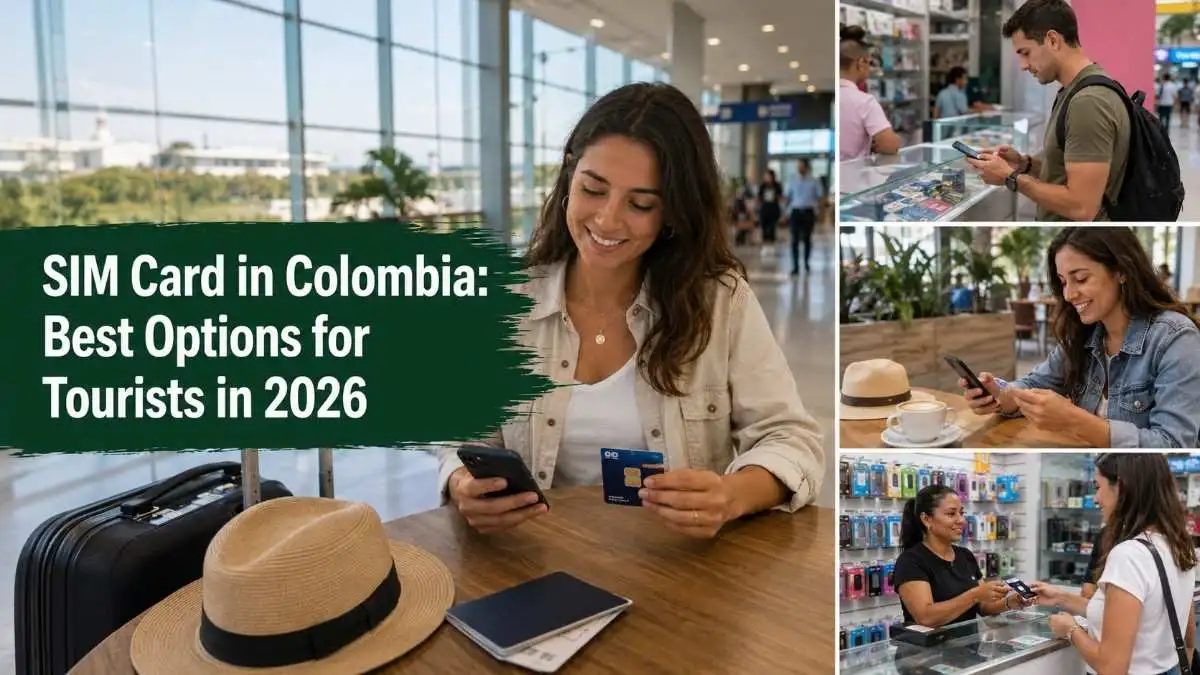
SIM card in Colombia is one of the first things you should sort out after landing, especially if you need Google Maps, WhatsApp, Uber, hostel bookings, or bank alerts during your trip.
Colombia is easy to travel, but moving around without mobile data can be stressful. Wi-Fi is common in hotels, cafés, and airports, but it won’t help much when you are trying to order a ride outside the terminal or check directions in a busy street.
For most tourists, Claro is the safest first choice because it usually has better coverage across the country. Tigo and Movistar can work well in big cities, and an eSIM is useful if you want data before you land.
This guide explains the best SIM card options in Colombia, where to buy one, how much it costs, which network to choose, and what to know before using your phone in Colombia.
If your Colombia trip starts in the capital, read my Bogotá Airport to City guide before arrival. It can make your first hour in Colombia much easier.
Do tourists need a SIM card in Colombia?
A SIM card is worth it in Colombia if you plan to use maps, rideshare apps, WhatsApp, translation apps, or online bookings.
You can travel with hotel Wi-Fi only, but it gets annoying fast. Some streets have poor public Wi-Fi. Some bus stations are confusing. Taxi prices can be hard to check without data. A local SIM fixes most of that.
A SIM card is useful for:
- Google Maps and walking routes
- Uber, DiDi, Cabify, or inDrive
- WhatsApp with hotels, tour guides, and drivers
- Bus tickets and flight updates
- Restaurant searches
- Emergency calls
- Translation apps
- Checking safety routes at night
I would buy a SIM card or eSIM for any Colombia trip longer than 3 days. If you are still checking entry rules, my Colombia Visa Requirements guide can help you prepare the basic documents before your trip.

If your phone accepts eSIM and your trip is short, an eSIM is fine. If your trip is 7 days or more, a local SIM usually gives better value.
Best mobile networks in Colombia
Colombia has several mobile operators, but tourists usually compare Claro, Tigo, and Movistar.
WOM also exists, and some smaller brands use bigger networks. For a first trip, I would keep things simple and choose one of the main 3.
Claro Colombia
Claro is my top pick for most travelers.
It is usually the best option if your Colombia route includes more than one region. That means Bogotá, Cartagena, Medellín, Salento, Santa Marta, Tayrona, Minca, or smaller towns.
Claro is a good choice if you want fewer signal problems on buses and day trips. No Colombian network is perfect in mountains, jungle, or remote beaches, but Claro is still the safer pick for mixed travel.
Choose Claro if:
- You are visiting more than one city
- You need better coverage outside city centers
- You plan to visit Tayrona, Minca, Salento, or coffee towns
- You want the simplest tourist choice
Claro prepaid SIM cards are easy to find in official stores, malls, airports, and phone shops. Take your passport with you.
If your Colombia plan includes nature and beach time, my Tayrona National Park Guide can help you plan the part of the trip where signal may be weaker.
Tigo Colombia
Tigo is a strong option for city travelers and budget travelers.
Its prepaid packages are often clear and easy to compare. Tigo is good if you stay mostly in Bogotá, Medellín, Cartagena, Cali, or other urban areas.
Tigo can also be a good choice if you want a simple package with data, minutes, SMS, WhatsApp, and Facebook included. Check the current package before buying because promotions change.
Choose Tigo if:
- You find a better package than Claro
- You are staying mostly in cities
- You want a simple prepaid plan
- You are comfortable buying online or through the app after activation
Tigo also sells prepaid SIM and eSIM options through its own channels, but tourists may still find it easier to visit a store.
Movistar Colombia
Movistar can work well in big cities and tourist zones, especially for short city stays.
It has prepaid packages with data, minutes, messages, and apps. Some plans also include social apps. If you are only staying in Bogotá, Medellín, or Cartagena, Movistar can be fine.
For remote travel, I would check coverage before choosing Movistar. In rural areas, beaches, mountains, and jungle zones, the signal can vary a lot.
Choose Movistar if:
- You are staying in major cities
- You find a good short package
- You already use Movistar in another country
- You want a prepaid plan for a few days
For a full Colombia trip with buses, beaches, and smaller towns, I would still choose Claro first.

If you are tired after a long flight, an airport SIM is convenient. If you want a better price, wait until you reach a mall or official store in the city.
Can you buy a SIM card at Bogotá Airport?

Yes, you can usually buy a SIM card at Bogotá El Dorado Airport. Options may change by terminal and arrival time, so don’t depend on one specific kiosk being open late at night.
Airport SIM cards are useful if you need data right away for a ride, hotel message, or map.
The downside is price. Airport SIMs often cost more than buying the same type of service in the city.
A good plan is:
- Use airport Wi-Fi when you land.
- Order your ride or message your hotel.
- Buy a SIM at the airport only if you need it right away.
- Buy from an official store in the city if you can wait.
If you are arriving late, it may be easier to use an eSIM for the first day and buy a local SIM the next morning.
Can you buy a SIM card at Cartagena Airport?

You may find SIM card options at Cartagena Airport, but choices can be limited compared with Bogotá.
If your hotel is in Centro Histórico, Getsemaní, Bocagrande, or Manga, you can usually buy a SIM in the city after checking in. Cartagena has malls, operator stores, and many small phone shops.
For a short Cartagena trip, an eSIM can be the easiest option. For a longer Colombia trip, buy a local SIM once you are settled.
If you are landing on the Caribbean coast, my Cartagena Airport to City guide can help you plan transport after buying a SIM or connecting your eSIM
Documents needed to buy a SIM card in Colombia
Take your passport when buying a SIM card in Colombia.
The shop may ask for:
- Passport
- Entry stamp or proof of entry
- Local address, such as your hotel
- Email address
- IMEI number
- Basic personal details
You can find your IMEI by dialing *#06# on your phone.
The staff should register the SIM under your name. Ask them to activate the package and test mobile data before you leave the store.
Use this Spanish line if needed:
“Quiero comprar una SIM prepago con datos. ¿Me puede ayudar a activarla?”
This means you want to buy a prepaid SIM with data and need help activating it.
Phone registration and IMEI rules in Colombia
Colombia has phone registration rules. If you use a Colombian SIM for a longer stay, your phone may need IMEI registration.
For a short tourist trip, many people use a SIM without trouble. For trips longer than 2 or 3 weeks, ask the operator store to register your phone properly.
You should also check that your phone is unlocked before you travel. If your phone is locked to your home carrier, a Colombian SIM will not work.
Before your trip, check these 3 things:
- Your phone is unlocked
- Your phone supports Colombian network bands
- You know how to find your IMEI
If the store staff says your phone needs registration, do it there. It is easier than fixing a blocked phone later.
How much does a SIM card in Colombia cost?
A SIM card in Colombia is cheap compared with many travel eSIMs.
A basic prepaid SIM card may cost only a few thousand Colombian pesos. The main cost is the data package.
For most tourists, a practical budget is:
Prices change often because operators run short promotions. Check the current package in the store or app before paying.
As a rough guide, COP 20,000 is usually enough for a simple tourist data package. Heavy users should budget more.
For a wider money plan, my Bogotá Cost Per Day guide can help you compare mobile data with food, transport, and attractions.
Best prepaid SIM packages in Colombia
Prepaid packages change often, but most tourist-friendly plans include data, local minutes, SMS, and some app use.
A good tourist package should have:
- At least 4 GB of data for a short trip
- 10 GB or more for a 2 week trip
- WhatsApp included if possible
- Enough validity for your full stay
- Easy recharge options
Here’s a simple guide:
If you watch videos, upload reels, use maps all day, or share hotspot with a laptop, buy more data. Colombia is a place where you may use your phone often for routes, safety checks, and rides.
Before buying an eSIM, check:
- Your phone supports eSIM
- Your phone is unlocked
- The eSIM includes Colombia
- The plan has enough days
- Hotspot sharing is allowed if you need it
- Calls and SMS are included or data-only
Many eSIMs are data-only. That is fine for WhatsApp, Google Maps, Uber, Instagram, and email. It may be a problem if an app asks for a Colombian SMS code.
An eSIM is better for ease. A local SIM is usually better for price.
Choose an eSIM if you want to land with data already working. This is helpful at night, after long flights, or if you don’t speak Spanish.
Choose a local SIM if you want cheaper data and a Colombian number. This is better for longer trips and budget travel.
Some travelers use both. They activate an eSIM before landing, then buy a Claro SIM once they are settled.
How to activate a SIM card in Colombia
If you buy from an official store, ask the staff to activate everything for you.
Before leaving the store, check:
- Your phone shows signal.
- Mobile data works.
- WhatsApp still works.
- You know your Colombian number.
- You know when the package expires.
- You know how to recharge.
If mobile data does not work, ask the staff to check the APN settings.
Use this Spanish line:
“¿Puede revisar que los datos móviles funcionen antes de irme?”
This means you want them to check that mobile data works before you leave.
How to recharge your SIM card in Colombia

Recharging a SIM card in Colombia is easy once your line is active.
You can recharge through:
- Operator apps
- Official websites
- Convenience shops
- Supermarkets
- Pharmacies
- Phone kiosks
- Some payment apps
- Street recharge vendors
For tourists, the easiest option is usually a shop or supermarket. Tell the cashier your operator, phone number, and amount.
Use this Spanish line:
“Quiero hacer una recarga de 20 mil pesos para Claro.”
Change Claro to Tigo or Movistar if needed.
After recharging, you may need to buy a data package. Balance and data package are not always the same thing.
Ask:
“¿Ese valor incluye paquete de datos?”
This means: does that amount include a data package?
Can you use WhatsApp with a Colombian SIM card?
Yes, WhatsApp usually keeps your original number even after you put in a Colombian SIM.
When WhatsApp asks if you want to change your number, choose to keep your current number. That way, your contacts can still message you as usual.
A Colombian SIM only changes your mobile service. It does not have to change your WhatsApp identity.
This is useful because hotels, tour guides, and drivers in Colombia often use WhatsApp.
Mobile coverage in Bogotá, Medellín, and Cartagena

Mobile coverage is usually good in Bogotá, Medellín, Cartagena, Cali, and other large cities.
In Bogotá, signal is usually fine in tourist zones such as La Candelaria, Chapinero, Usaquén, Zona T, and around the airport. Coverage may drop inside thick buildings or underground areas. If you are choosing where to stay in the capital, my Where to Stay in Bogotá guide can help you compare safer and more useful areas for first-time visitors.
In Medellín, signal is usually good in El Poblado, Laureles, Envigado, and central areas.
In Cartagena, signal is usually fine in Centro Histórico, Getsemaní, Bocagrande, Manga, and the airport area. Some island trips have weaker signal.
If your route stays inside major cities, Tigo, Movistar, and Claro can all work. If your route includes smaller towns, long bus rides, or nature areas, Claro is the safer pick.
Mobile coverage in Tayrona, Salento, and rural Colombia

Coverage can be uneven in rural Colombia.
This matters if your trip includes Tayrona National Park, Minca, Palomino, Salento, Cocora Valley, Guatapé backroads, Amazon areas, Pacific coast towns, or mountain roads.
Do not expect strong signal everywhere in:
- National parks
- Jungle areas
- Remote beaches
- Mountain valleys
- Long-distance buses
- Small villages
- Islands near Cartagena
Download offline Google Maps before leaving the city. Save your hotel address, bus station, and main route. Tell someone your plan if you are hiking or moving between towns. If Salento is part of your route, my Cocora Valley Colombia Guide can help you plan the day where mobile signal may be weaker.
A SIM card is useful, but it cannot fix weak rural signal.
Can you use public Wi-Fi in Colombia?
Yes, but public Wi-Fi should be a backup.
Hotels, cafés, restaurants, coworking spaces, airports, and some malls often have Wi-Fi. The quality varies.
Avoid using public Wi-Fi for banking unless you trust the network. Use mobile data for sensitive logins when possible.
Public Wi-Fi is fine for basic browsing, maps, and messages. For transport apps, safety checks, and directions, mobile data is much better.
Safety tips for using your phone in Colombia
Phone theft can happen in busy areas, buses, nightlife zones, and crowded streets.
Use your phone carefully, especially in big cities.
Simple safety habits:
- Don’t hold your phone loosely near the road.
- Step inside a shop before checking maps.
- Use one earbud if you need directions while walking.
- Keep your phone away on buses and at traffic lights.
- Avoid standing outside with your phone late at night.
- Use rideshare apps from safer pickup points.
- Keep your backup codes saved somewhere safe.
If you use your phone for photos, take it out, take the photo, and put it away.
This matters in Bogotá, Medellín, Cartagena, Cali, and busier tourist streets.
Most SIM issues are easy to fix if you are still near the store.
Before leaving the shop, open Google Maps, WhatsApp, and a website. If all 3 work, you are probably fine.
Should you buy a SIM card before traveling to Colombia?
You can buy an eSIM before traveling, but you usually cannot buy a normal Colombian physical SIM from abroad in a useful way.
For most tourists, there are 2 smart options:
Buy an eSIM before flying if you want data right after landing.
Buy a local SIM after arrival if you want the best price.
If you are nervous about arrival, buy a small eSIM for the first 1 or 2 days. Then buy a local SIM in Colombia once you are settled.
Best SIM card plan for a 1 week Colombia trip
For 1 week in Colombia, choose a package with at least 4 GB to 8 GB.
This is enough for maps, WhatsApp, basic browsing, restaurant searches, and rideshare apps. It may not be enough if you watch videos or upload many photos and reels.
For 1 week, I would choose:
- Claro if moving between cities
- Tigo if staying in one city and the package is cheaper
- eSIM if arriving late or staying only in tourist zones
A 7 day Colombia trip often includes airport transfers, maps, taxis, and last-minute bookings. Don’t go too low on data. If Cartagena is part of your 1 week route, my Is Cartagena Expensive guide can help you plan food, transport, and mobile data in one budget.
Best SIM card plan for a 2 week Colombia trip
For 2 weeks, choose at least 10 GB to 15 GB.
A 2 week Colombia route may include Bogotá, Medellín, Cartagena, Salento, Santa Marta, or Tayrona. That means more transport days and more map use.
For this type of trip, I would pick Claro prepaid. It gives the best mix of coverage and simple access.
If you are trying to choose travel dates, read my Best Time to Visit Colombia guide before buying flights. Weather can change how much time you spend moving between regions.
Best SIM card plan for digital nomads in Colombia
Digital nomads should not depend on mobile data alone.
A local SIM is useful for backup data, rides, maps, and hotspot use. For daily work, choose accommodation with strong Wi-Fi and check reviews before booking.
For backup mobile data, choose a larger package from Claro or Tigo. If your phone supports dual SIM, keep an eSIM or home SIM as a backup.
Good cities for easier work setup include Medellín, Bogotá, and Cartagena. Smaller towns can be lovely, but Wi-Fi and mobile signal may vary by street, building, and weather.
Best SIM card for backpackers in Colombia
Backpackers should usually buy a local SIM, not a travel eSIM.
The price is better, recharges are easy, and you can buy data as you move. Claro is the easiest pick if your route includes buses, hostels, small towns, and national parks.
A good backpacker setup is:
- Claro prepaid SIM
- 10 GB or more data
- Offline Google Maps
- WhatsApp active with your usual number
- Power bank for long bus days
This setup works well for routes through Bogotá, Salento, Medellín, Santa Marta, Tayrona, and Cartagena.
Best SIM card for couples and families
Couples and families can save money by buying 1 or 2 local SIM cards instead of one for every person.
A simple setup:
- 1 main phone with Colombian SIM
- 1 backup phone with eSIM or home roaming
- Offline maps on both phones
- Hotel address saved on both phones
Check whether hotspot sharing is allowed on your plan. Some eSIMs limit hotspot use, and some local packages may slow down after heavy use.
For families, it is safer if at least 2 phones can connect without Wi-Fi.
Local SIM card mistakes to avoid
Avoid buying the first SIM from a random seller if you do not understand the package.
Ask what is included, how many days it lasts, and whether the data package is active now.
Avoid these mistakes:
- Buying a SIM without passport registration
- Leaving the store before testing data
- Buying only balance, then forgetting to activate a package
- Choosing a plan with too little data
- Assuming signal works in every rural area
- Forgetting to check if your phone is unlocked
- Losing your home SIM card after removing it
Keep your home SIM in a safe place. A small zip pocket in your passport holder works well.
Useful sentence:
“Necesito una SIM prepago con datos para 15 días.”
This means you need a prepaid SIM with data for 15 days.
Another useful sentence:
“¿Cuántos gigas incluye?”
This means: how many GB are included?
Final advice
For most tourists, the best SIM card in Colombia is Claro prepaid. It is easy to find, simple to recharge, and usually the safer choice if your trip includes more than one region.
Tigo and Movistar can be good in cities, especially if you find a cheaper package. For short trips, late-night arrivals, or stress-free setup, an eSIM is a good backup.
My simple advice is this: use an eSIM if you want data before landing, then buy a Claro SIM in Colombia if your trip is longer than a few days.
Before you pay, ask the staff to register the SIM, activate the package, and test the data on your phone. That one step can save you a lot of trouble later.