
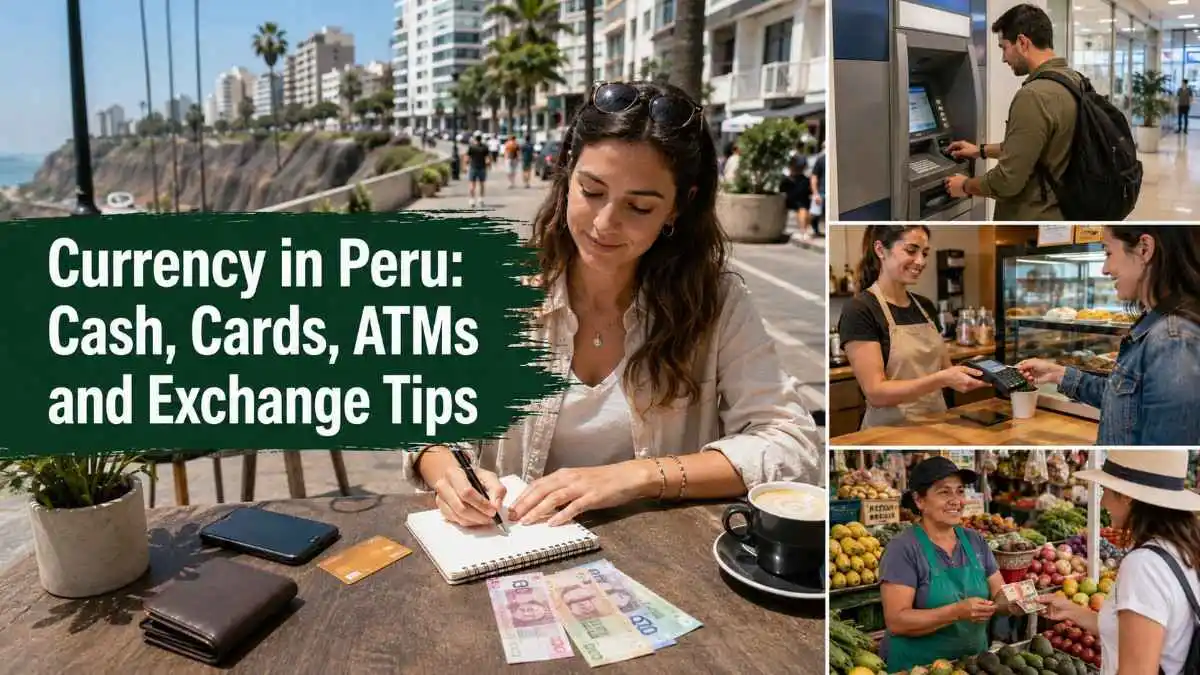
Currency in Peru is one of the first things you should learn before you land, because money mistakes can cost you extra at airports, ATMs, taxis, markets, and small restaurants.
Peru is easy to visit once you know how payments work. Big cities like Lima and Cusco accept cards in many places, but cash is still needed for street food, buses, local markets, tips, small shops, and some day tours.
I learned this the simple way: always keep small soles in your pocket. A card may work at your hotel or a nice café, but it may be useless when you need a bottle of water, a taxi, or a snack near a bus station.
Quick answer: what currency does Peru use?

Peru uses the Peruvian sol.
The currency code is PEN. The symbol is S/. You will see prices written like this:
S/5
S/10
S/25
S/100
The plural of sol is soles. So, if something costs S/30, people may say “treinta soles.”
For most travelers, the best payment plan is simple:
Use soles for daily spending.
Use a travel card or credit card in hotels, larger restaurants, and supermarkets.
Carry small notes for taxis, markets, local buses, tips, and rural areas.
Keep some U.S. dollars as backup if you are bringing cash.
Current exchange rate in Peru
The exchange rate changes every day. As a rough guide in June 2026, 1 U.S. dollar is around S/3.39.
This means:
Use this as a travel estimate. Check the live rate before you exchange money or withdraw cash.
The rate you see online is usually the mid-market rate. A bank, ATM, airport counter, or exchange office may give a slightly lower rate because they add their own fee or spread.
Should you use soles or U.S. dollars in Peru?
Use soles for normal daily spending.
Some hotels, tour agencies, and higher-end travel services may accept U.S. dollars, especially in tourist areas. Still, soles are easier for food, transport, markets, cafés, shops, tips, and small entrance fees.
U.S. dollars can be useful as backup cash. They are easier to exchange than many other currencies in Peru.
Bring clean, newer dollar bills if you plan to exchange them. Torn, marked, old, or damaged notes may be rejected. This can happen even if the bill is still legal in your home country.
Can you pay with U.S. dollars in Peru?
Yes, in some places.
You may be able to pay in U.S. dollars at:
Hotels
Tour agencies
Some airport services
Private transfers
Some higher-end restaurants
Machu Picchu tour offices
Travel services in Cusco and Lima
For normal daily costs, pay in soles.
A small restaurant, local bus, market stall, or taxi driver may refuse dollars. If they accept dollars, the exchange rate may be poor.
Should you exchange money before going to Peru?
You do not need to exchange all your money before arrival.
A small amount of soles can be useful for your first day. This is helpful if you arrive late, need a taxi, want water, or do not want to find an ATM right away.
For most travelers, this is enough for arrival:
S/100 to S/200 in small notes
One travel card or debit card
One backup card
Some U.S. dollars in clean notes
If you are flying into Lima, you can use an ATM at the airport or exchange a small amount there. Airport exchange rates are usually weaker, so do not exchange a large amount unless you have no choice.
If your first stop is Lima, this Lima Airport to Miraflores guide can help you plan your arrival transport before you start spending cash.
Best places to exchange money in Peru

The best places to exchange money in Peru are banks and trusted exchange offices called casas de cambio.
You will find many exchange offices in Lima, Cusco, Arequipa, and other tourist areas. Rates can vary, so compare 2 or 3 places if you are changing a larger amount.
Good places to exchange money:
Banks
Casas de cambio
Reliable exchange counters in safe tourist areas
Your hotel, only for small emergency exchanges
Places to avoid:
Random street money changers
Very busy sidewalks
Exchange counters with no posted rate
Anyone who rushes you
Airport counters for large amounts
Always count your money before leaving the counter. Check the notes too.
Using ATMs in Peru

ATMs are common in big cities and tourist areas. You will find them in Lima, Cusco, Arequipa, Puno, and many larger towns.
ATMs may charge a local fee. Your home bank may also charge a foreign withdrawal fee.
Before your trip, check:
Foreign ATM fee
Foreign transaction fee
Daily withdrawal limit
Card lock settings
Emergency card contact number
If your bank lets you set a travel notice, do it before leaving.
Should you accept ATM conversion?
This is usually better because your own bank or card network handles the conversion. If you accept the ATM’s conversion, the rate can be worse.
The screen may ask something like:
“Accept conversion?”
“Charge in USD?”
“Use guaranteed rate?”
Pick the option that keeps the charge in PEN or soles.
Can you use credit cards in Peru?

Yes, credit cards work well in many tourist areas.
Cards are useful in:
Hotels
Supermarkets
Large restaurants
Airports
Shopping malls
Tour offices
Some bus companies
Better cafés in Lima and Cusco
Visa and Mastercard are the safest choices. American Express is accepted in fewer places. For restaurant planning in the capital, our Where to Eat in Lima guide can help you decide when to use cash and when a card may work better.
Cash is still better for:
Street food
Small cafés
Markets
Local taxis
Small hostels
Public buses
Small towns
Tips
Bathroom fees
Small entrance fees
Some businesses add a card fee, often around 3% to 5%. Ask before paying.
Is Peru cash-based?

Peru is partly cash-based.
In Lima’s tourist areas, card payment is common. In Miraflores, Barranco, San Isidro, and central tourist zones, you can use cards for many meals and hotel payments.
In smaller towns and local areas, cash matters more. The same is true for hikes, rural tours, local markets, and roadside shops.
If you are planning a longer Peru route with Cusco, Puno, Arequipa, or the Sacred Valley, keep cash ready before moving between places.
For trip timing, this Best Time to Visit Peru guide can help you avoid weather problems that may affect transport and cash access in smaller areas.
How much cash should you carry in Peru?
Travelers trying to spend less on meals can use our Cheap Street Food in Lima guide to plan small cash spending.
Peruvian banknotes and coins
Peru uses banknotes and coins.
Common banknotes:
S/10
S/20
S/50
S/100
S/200
Common coins:
10 céntimos
20 céntimos
50 céntimos
S/1
S/2
S/5
For travelers, S/10, S/20, and S/50 notes are the most useful.
S/100 notes are accepted in larger shops and restaurants, but small sellers may not have change. S/200 notes can be harder to use for daily spending.
Try to break large notes at supermarkets, pharmacies, or larger restaurants.
Small change matters in Peru
Small change can save you stress in Peru.
You may need coins or small notes for:
Public bathrooms
Local buses
Street snacks
Bottled water
Tips
Markets
Taxi rides
Short tuk-tuk rides in some towns
Small entrance fees
If you pay for a S/4 snack with a S/100 note, the seller may refuse it. Keep small notes ready.
A good habit is to break larger notes whenever you buy something at a supermarket or pharmacy.
How to spot fake money in Peru
Fake currency can be a problem in Peru, including fake soles and fake U.S. dollars.
You do not need to become an expert, but you should check notes before accepting them.
Basic checks:
Feel the note. Real notes usually have a clear texture.
Look for the watermark. Hold the note to the light.
Check the security strip.
Look at the print quality. Blurry print is a warning sign.
Avoid damaged or taped notes.
Be extra careful with S/100 and S/200 notes.
Do not exchange money with people on the street. If someone gives you a suspicious note, ask for another one right away.
Is tipping expected in Peru?
Tipping is common in tourist areas, but it is usually small.
Simple tipping guide:
Restaurant with table service: 10% if service is good
Small local restaurant: round up or leave S/2 to S/5
Tour guide: S/10 to S/30 per person for a day tour
Private driver: S/10 to S/20 if service is good
Hotel porter: S/2 to S/5 per bag
Housekeeping: S/5 to S/10 per day
Tip in soles when possible. It is easier for local staff to use.
Are prices in Peru shown with tax?
Many prices already include tax, especially in shops and restaurants.
Peru has an 18% IGV, which is similar to VAT. In normal shops, cafés, and restaurants, the price you see often includes tax. In hotels or tour quotes, check the final price before paying.
Ask these simple questions:
“Is this the final price?”
“Does this include tax?”
“Is card payment the same price?”
Some hotels may show prices in U.S. dollars online, then charge in soles at the property. Check the exchange rate they use.
Money safety tips for Peru

Peru is a popular travel country, but money safety still matters.
If a taxi driver, guide, or shop worker says they have no change, ask nearby shops to break the note before paying.
How much money can you bring into Peru?
You must declare cash if you carry more than US$10,000 or the same value in another currency.
Peru also has strict rules for amounts over US$30,000.
Most normal tourists will not travel with that much cash. Still, this rule matters if you are carrying money for a long trip, family visit, business trip, or group travel.
For a normal tourist trip, cards plus a smaller amount of cash are safer.
Best money plan for Lima

Lima is the easiest city in Peru for card payments.
In Miraflores, Barranco, San Isidro, and major shopping areas, you can pay by card in many restaurants, hotels, cafés, and supermarkets.
Carry cash for:
Taxis
Street food
Markets
Tips
Small cafés
Local buses
Walking tours
If you are staying near the coast, you may find this Miraflores vs Barranco guide useful before choosing your base.
Best money plan for Cusco and Machu Picchu
Cusco has many ATMs, exchange offices, tour agencies, and card-friendly restaurants. Still, cash is very useful.
Carry soles for:
San Pedro Market
Taxis
Tips
Small restaurants
Sacred Valley stops
Local transport
Souvenirs
Some tour extras
Before visiting Machu Picchu, withdraw cash in Cusco or Aguas Calientes. Do not depend on finding the perfect ATM at the last minute.
Small notes are very useful in the Sacred Valley.
Best money plan for Arequipa, Puno, and smaller towns
Arequipa has good ATM and card access in central areas.
Puno and smaller towns need more cash planning. ATMs may be fewer, and card payment may be less common outside hotels and larger restaurants.
If you are going to Lake Titicaca, Colca Canyon, Huaraz, or rural areas, withdraw cash before leaving the city.
For rural routes, carry:
S/10 notes
S/20 notes
Coins
One emergency S/100 note
A backup card
Do not rely on one card only.
What is the cheapest way to get cash in Peru?
The cheapest way depends on your bank card.
For many travelers, the cheapest method is:
Use a debit card with low foreign fees.
Withdraw soles from a bank ATM.
Choose to be charged in soles.
Withdraw enough for a few days, so you do not pay ATM fees again and again.
Keep cash split in more than one safe place.
Do not withdraw more than you can safely carry.
If your bank has high international fees, compare travel cards before your trip.
Should you use Wise, Revolut, or a travel card in Peru?
A travel card can work well in Peru, especially in Lima and Cusco.
Wise, Revolut, and similar cards can help reduce bad exchange rates, depending on your country and account rules. They are useful for card payments and ATM withdrawals.
Still, carry a backup bank card. Some ATMs may reject one card and accept another.
Before travel, check:
ATM withdrawal limit
Free withdrawal amount
Foreign exchange fee
Weekend exchange fee
Card replacement options
App login access abroad
Do not depend on one app or one card.
Common Peru money mistakes
Many first-time visitors make the same money mistakes.
They exchange too much money at the airport.
They carry too many large notes.
They forget coins and small bills.
They accept poor ATM conversion.
They use street money changers.
They keep all cards in one wallet.
They do not check card fees before travel.
They forget that small towns may need cash.
They accept damaged notes.
They do not count cash before leaving the exchange counter.
Most of these are easy to avoid with a little planning.
This is cash to carry, not your full daily budget. You may pay hotels, flights, and bigger tours by card. If your Peru trip starts in the capital, read our Is Lima Expensive guide to compare food, transport, and daily costs before setting your cash limit.
What to do if your card stops working in Peru
Do not panic. This happens to travelers.
Try these steps:
Use a different ATM.
Try a bank ATM inside a branch.
Use your backup card.
Check your banking app for blocks.
Turn your card on for international use.
Contact your bank through the app.
Use cash backup while fixing the issue.
If your card is swallowed by an ATM, contact the bank branch right away if it is open. If it happens after hours, call the number on the ATM and your home bank.
This is why it is smart to carry 2 cards from different banks.
Final tips for using currency in Peru
Currency in Peru is easy once you use the right mix of cash and cards. Use soles for daily spending, keep small notes for local payments, and use cards in larger businesses where it feels safe.
The best plan is simple: arrive with a little cash, withdraw soles from safe ATMs, avoid street money changers, and keep a backup card. In big cities, card payment can save time. In small towns, cash will save you from stress.